Micro-Credits, Corporate Co-Authorship and AI Integration: How ISB&M Pune is Re-Engineering the PGDM
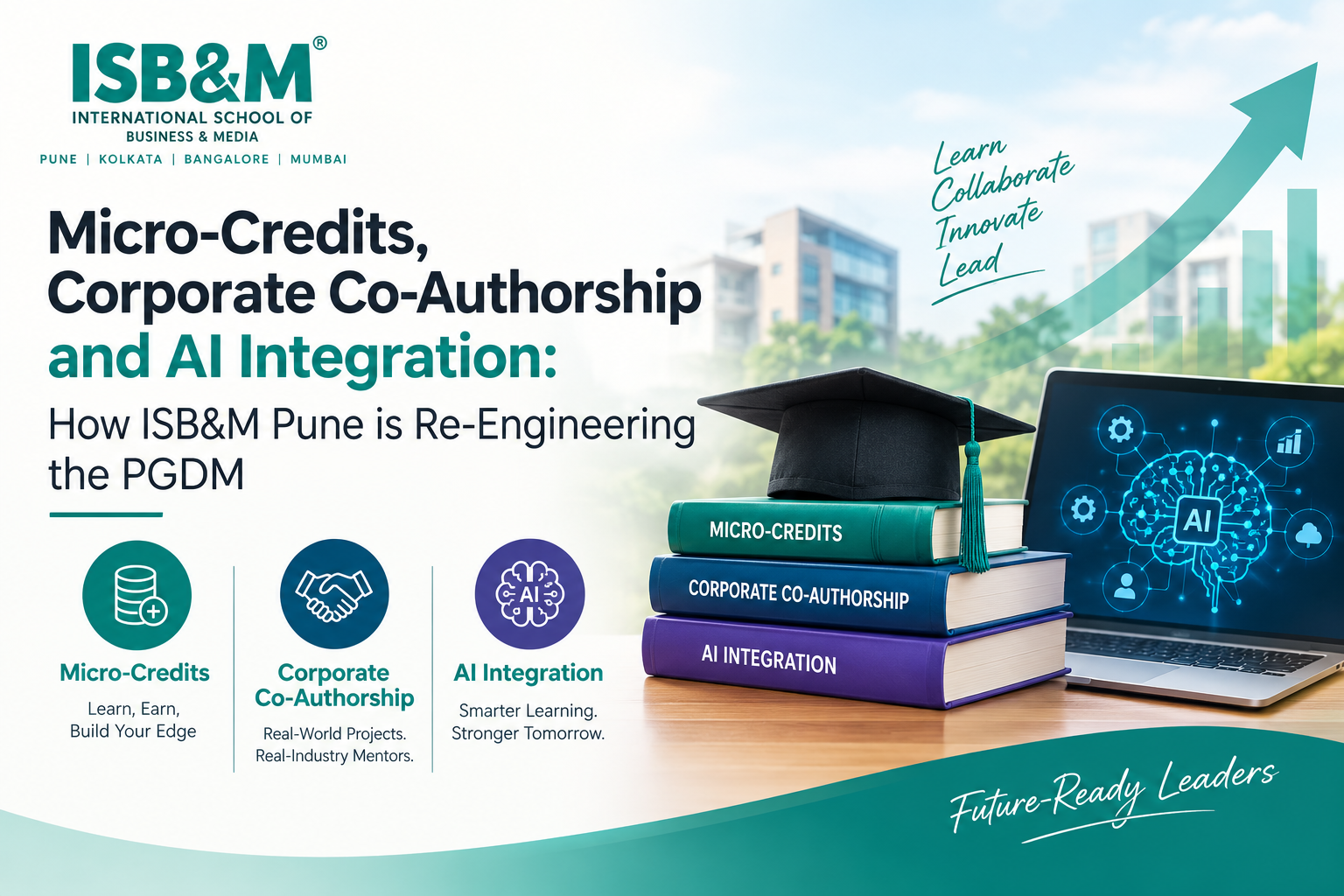
Micro-Credits, Corporate Co-Authorship and AI Integration: How ISB&M Pune is Re-Engineering the PGDM
Pune, long celebrated as the Oxford of the East, is once again at the forefront of higher education reform. As traditional semester-long courses and high-stakes final exams struggle to match the agility demanded by the modern workforce, business schools in the city are redesigning management pedagogy for digital-native professionals who thrive on milestone-based progress and immediate application.
At the International School of Business & Media (ISB&M), Nande, this transformation is visible in the AICTE-approved dual-specialisation PGDM. Founded in 2000 by Dr. Pramod Kumar, the institute has built its identity on industry-connected learning. Its latest programme structure—detailed on the institute’s core programme pages—introduces a modular, credit-driven framework that aligns closely with the needs of an AI-influenced corporate world.
The PGDM is delivered across six terms over two years and totals 160 credits. Crucially, each credit represents 10 hours of classroom contact. Courses are differentiated by intensity: three-credit modules cover fundamental knowledge and may themselves be broken into smaller segments; two-credit courses address essential domain competencies; and one-credit modules focus specifically on recent advances, contemporary problems and emerging issues. This “chunked” design eliminates the lag between teaching and evaluation. Students complete end-module assessments immediately after each segment, supported by continuous evaluation through cases, simulations, projects, quizzes and assignments. The result is sustained engagement and measurable mastery rather than end-of-term cramming.
The pedagogy rests on a 70/20/10 model: 70 percent experiential and application-oriented learning, 20 percent interaction and collaboration, and only 10 percent formal conceptual input. Case discussions, business simulations and team-based company projects form the core. For the practical dimension, corporate leaders and industry practitioners regularly step in as co-facilitators. Students undertake company-based projects on live organisational themes (approved by faculty), participate in industry workshops, and complete a roughly 10-week summer internship after Term III. A mandatory dissertation in the second year further develops independent research and analytical capability. This corporate co-authorship ensures that theory is tested against real business challenges in real time.
Technology and artificial intelligence are woven into the curriculum rather than treated as add-ons. Business Analytics is offered as a full dual-specialisation option, allowing students to combine it with Marketing, Finance, Human Resource Management, Logistics & Supply Chain Management or Media & Communication. Core and foundation elements include Introduction to Data Sciences & Business Analytics, Basics of Data and Analytics, and IT tools for managers. Marketing tracks incorporate digital marketing with generative AI components. One-credit modular courses are explicitly designed to address emerging developments—precisely the space where AI tools, data-driven decision frameworks and new business processes can be introduced and updated rapidly. The institute’s curriculum is periodically reviewed against cutting-edge industry requirements, ensuring that graduates encounter the same technologies shaping their future workplaces.
Across the dual-specialisation programme, students complete substantial contact hours (160 credits × 10 hours). A significant share is applied and corporate-led, delivering hundreds of hours of practical exposure through workshops, live projects, guest sessions by senior executives, the summer internship and the dissertation. Dual specialisation—30 credits of core-plus-elective depth in each of two functional areas, plus additional electives—builds cross-functional judgement. Students learn not only the concepts of two domains but how they intersect in technology-enabled organisations.
The outcomes reflect this design. Recent batches have recorded near-100 percent placements, with average packages around ₹11.4 LPA and the highest reaching approximately ₹20.56 LPA. Recruiters span BFSI, consulting, IT, e-commerce and FMCG. More than 12,000 alumni work across 46 countries in leadership roles at organisations that increasingly rely on AI and analytics. The combination of modular mastery, continuous evaluation, corporate co-facilitation and deliberate technology integration produces graduates who can analyse data, apply AI-enabled tools and contribute from day one.
Dr. Pramod Kumar’s founding emphasis on high standards, national and global character, and mutual growth continues to shape the institute. In Pune’s evolving higher-education landscape, ISB&M’s micro-credit architecture, corporate co-authored classrooms and embedded AI/analytics focus represent a practical response to the demands of the next-generation professional—agile, application-oriented and technologically fluent.
600 Hours of Corporate Alignment: How ISB&M Pune Redefines Day-1 Corporate Readiness
PUNE: In the Oxford of the East, where management education has long balanced academic rigour with industry proximity, the International School of Business & Media (ISB&M), Nande, has refined a model that measures success by immediate professional readiness. Founded in 2000 by Dr. Pramod Kumar, the AICTE-approved dual-specialisation PGDM treats corporate engagement not as an add-on but as a structural feature of the two-year programme.
Rather than confining industry exposure to occasional guest lectures or a single internship, ISB&M embeds professional practice across the curriculum. Students run active cells such as the Corporate Relations Cell, organising interactions, managing logistics, and negotiating with industry partners. Flagship student-driven events amplify this training. HR Share, held annually since 2001, is a national HR conference that draws senior leaders from MNCs and Indian companies; recent editions have explored themes such as “Navigating the Future of Work: The Struggle for Space between Technology and People,” attracting 500-plus participants and more than 50 organisations. Parallel events such as Runbhoomi and Forza place students in the roles of project managers, requiring them to handle budgeting, brand partnerships, operations, and strategic execution at a scale that mirrors mid-sized corporate projects.
Live learning reinforces the same principle. The curriculum incorporates company-based projects on real organisational themes, continuous case analysis, and an intensive 8-to-10-week summer internship after the third term. These elements give students repeated practice in applying concepts to live business problems before they graduate. Industry workshops and sessions led by practising executives further compress the distance between classroom theory and workplace execution.
Placement outcomes reflect the cumulative effect. For recent cohorts, the institute has recorded near-100 percent placements. The highest package has stood at ₹20.56 LPA, with an average of ₹11.4 LPA and a median around ₹10.8 LPA. More than 150–160 recruiters have participated, spanning BFSI and financial services (approximately 24 percent of offers, including names such as BNY Mellon, ICICI Bank, and AllianceBernstein), corporate consulting (about 23 percent, including PwC, Deloitte, and L.E.K. Consulting), IT, analytics, and ITES (roughly 20 percent), e-commerce and digital platforms, and FMCG and retail. Summer internship stipends have reached as high as ₹1.25 lakh per month in recent cycles, with averages in the ₹40,000 range, and pre-placement offers have converted a meaningful share of internships into final roles.
The dual-specialisation structure—covering Marketing, Finance, Human Resource Management, Logistics & Supply Chain Management, Business Analytics, and Media & Communication—supports this breadth. Students build depth in two domains while the surrounding exposure ensures cross-functional fluency. Continuous evaluation, modular course design (with differentiated 1-, 2-, and 3-credit segments and 10 classroom hours per credit), and a heavy emphasis on experiential learning keep the programme aligned with shifting corporate requirements, including data-driven decision-making and technology-enabled processes.
Beyond campus, a network of more than 12,000 alumni across 46 countries extends the same readiness into careers. Graduates hold positions ranging from specialist roles to senior leadership in organisations across Asia, the Middle East, Europe, and North America. Many return as guest speakers, mentors, or recruiters, reinforcing the cycle of industry connection that shaped their own education.
In Pune’s competitive higher-education landscape, ISB&M’s approach demonstrates that day-1 corporate readiness is less the product of a final placement drive than of sustained, structured alignment between classroom and company. By integrating student-led professional bodies, large-scale industry events, live projects, mandatory internships, and modular experiential learning, the institute produces graduates who have already practised the responsibilities they will assume from the first day of employment. For employers seeking professionals who can contribute without extended induction, and for students aiming for rapid career traction, the model offers a clear, data-backed pathway.
Architects of Leadership: How ISB&M Pune’s Faculty Merges Elite Academics with Corporate Experience
PUNE: In the Oxford of the East, the quality of management education is often defined by the people who deliver it. At the International School of Business & Media (ISB&M), Nande, the faculty model deliberately combines advanced academic credentials with substantial corporate leadership experience. Founded in 2000 by Dr. Pramod Kumar—who holds a PhD in Organisational Behaviour from IIT Bombay, earlier associations with IIM Ahmedabad and XLRI, and a stint as Director of SIBM Pune—the institute has built its learning environment around this dual foundation.
Core faculty members draw academic training from institutions such as the IITs, IIMs, XLRI, SPJIMR, TISS, BITS Pilani, FMS, and others. At the same time, many bring years of industry practice that shape classroom discussion. This mix is intended to move students beyond theoretical frameworks toward the judgement required in real organisational settings.
Several profiles illustrate the approach. Dr. Prasanta Kumar De, who teaches operations, holds a PhD from IIT Kharagpur along with post-doctoral research in Germany, Denmark, and Ecuador. A former Dean of Academics at XLRI Jamshedpur, he has worked with organisations including Tata Motors, Maruti Udyog, and ISRO, and has served as a corporate consultant. Prof. S. B. Subramaniam, a Fellow Chartered Accountant with the ICAI, brings more than three decades of senior finance roles, including as CFO and Head of Finance at firms such as Force Motors and Tata Autocomp Systems. Dr. Subramaniam Jayaraman, an IIM Calcutta alumnus, combines postgraduate management education with extensive corporate experience in automobiles, construction, iron and steel, and IT services, having held responsibilities in sales, project management, quality, and human resources at organisations including TATA Metaliks. He has taught HR and organisational behaviour for more than two decades.
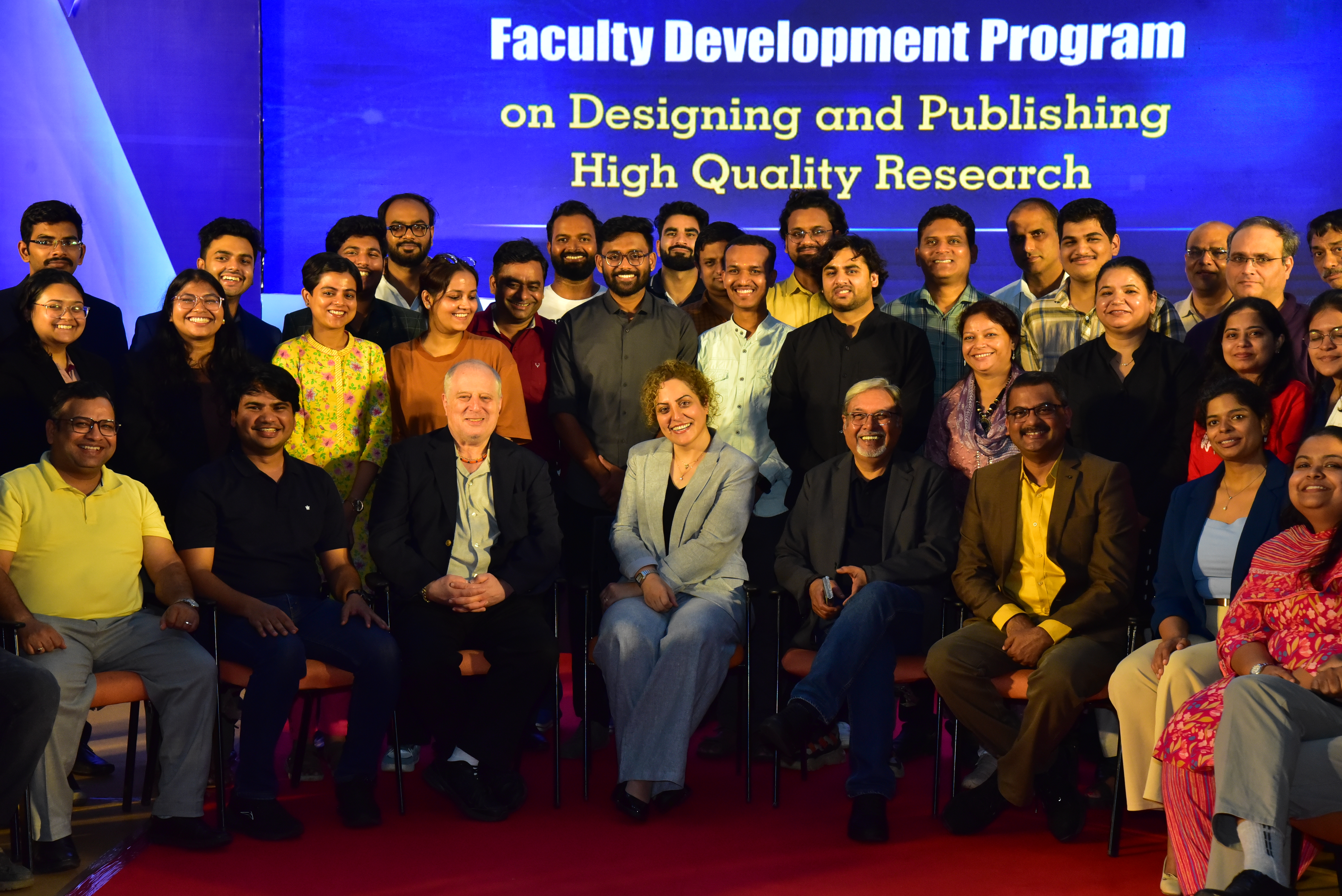
The broader roster includes other doctorates and specialists in finance, marketing, analytics, supply chain, media, and economics, many of whom maintain consulting or industry connections. Official descriptions note that students also interact with experienced corporate practitioners who contribute contemporary perspectives through guest sessions and workshops. The institute periodically hosts Faculty Development Programmes to support research and scholarly work, reinforcing the academic side of the faculty profile.
Pedagogy reflects the same dual orientation. The learning programme blends conceptual inputs with experiential methods: case discussions, business simulations, group projects, company-based assignments, and live industry projects. Continuous evaluation and structured feedback replace sole reliance on end-term examinations. A distinctive feature is Guided Self-Study (GSS), a faculty-approved mechanism that allows students to pursue chosen themes in greater depth under supervision. Students develop conceptual understanding, articulate ideas independently, and complete agreed assessments, typically involving substantial engagement beyond standard classroom hours. Small-group tutorials further support topical discussion and application.
This structure aligns with the programme’s overall design, which emphasises dual specialisation, modular credit delivery, and a high proportion of application-oriented learning. Faculty members act as mentors for career planning, internship monitoring, and dissertation guidance. The objective, as outlined by the institute, is to develop not only functional knowledge but also analytical ability, communication, leadership, and the capacity to adapt to changing business conditions.
In Pune’s competitive higher-education environment, ISB&M’s faculty model seeks to produce graduates who can contribute from the early stages of their careers. By drawing educators from both premier research institutions and senior corporate roles, and by embedding practical methods such as GSS, cases, and simulations into daily teaching, the institute positions its classrooms as a bridge between academic depth and organisational reality. For students preparing for dual specialisations in marketing, finance, human resources, logistics and supply chain, business analytics, or media and communication, the approach aims to deliver both rigorous frameworks and the applied insight needed in today’s workplaces.
The Global Footprint of Leadership: Mapping the Alumni Success Network of ISB&M Pune
PUNE: In the Oxford of the East, the long-term worth of a management institution is often measured by the trajectories of its graduates. Over more than two decades, the International School of Business & Media (ISB&M), Nande, has built a network of more than 12,000 alumni working across 46 countries. Founded in 2000 by Dr. Pramod Kumar, the institute’s early batches grew alongside the campus itself. When members of the 2001–2003 cohort returned for a silver-jubilee reunion, several described ISB&M as their “first startup”—a place where students helped shape the institution’s identity with limited resources, learning ownership, initiative, and problem-solving that later proved useful in corporate and entrepreneurial careers.
That early culture has translated into professional outcomes spanning banking and finance, media, consulting, human resources, supply chain, and technology-enabled businesses. Official alumni listings show graduates in senior roles at organisations including HSBC, DBS Bank, Credit Suisse, Morgan Stanley, Accenture, Cognizant, Volvo Group, and The Adecco Group, with concentrations in cities such as Singapore, Dubai, London, New York, and major Indian centres. Positions range from Vice President and Senior Vice President to Director-level responsibilities in HR, operations, marketing, and client management. Recent alumni updates have also highlighted individual milestones, including appointments such as Deputy CEO at VinFast India and the launch of a book by a 2002–04 alumnus who founded a firm.
The network extends beyond traditional corporate ladders. Pushpendra Singh, an ISB&M alumnus who completed postgraduate management studies in finance, is a co-founder of Centricity WealthTech, a Gurugram-based digital private wealth management platform launched in 2022. The company has raised significant capital, including a $20 million seed round led by Lightspeed at a reported valuation of $125 million, and has expanded its network of financial product distributors and assets under management. Other alumni have founded or co-founded ventures in consulting, content, hospitality, and specialised services, reflecting the institute’s emphasis on independent thinking alongside corporate readiness.
Media and communications alumni are visible in roles at organisations such as Viacom18, Amazon, Sony, and production or creative firms, consistent with the institute’s dual focus on business and media. Across functions, the distribution of roles shows depth in BFSI, consulting, IT and analytics, FMCG, and media—sectors that have also dominated campus placements in recent years, with recent cohorts recording near-100 percent placements, average packages around ₹11.4 LPA, and a highest package of ₹20.56 LPA.
The alumni connection is maintained through an active Alumni Cell that organises reunions, mentorship opportunities, and industry interactions. Many graduates return as guest speakers, recruiters, or contributors to workshops and curriculum feedback. This circular engagement supports the institute’s dual-specialisation PGDM, which combines modular, application-oriented learning with company-based projects, internships, and continuous industry exposure. Students encounter not only theoretical frameworks but also the practical expectations of workplaces where earlier cohorts already hold responsibility.
In Pune’s higher-education landscape, ISB&M’s alumni network functions as both a record of outcomes and an ongoing resource. Graduates occupy leadership and specialist positions across geographies and sectors, while newer batches benefit from the same emphasis on ownership, cross-functional skills, and industry alignment that shaped the pioneer cohorts. As the 2001–2003 batch demonstrated at their reunion, the institutional experience continues to inform professional journeys long after graduation—whether in multinational roles, senior corporate leadership, or entrepreneurial ventures. For an institute that has operated for more than 27 years, the global footprint of its alumni offers a concrete measure of sustained relevance. www.isbm.ac.in